
The brief
A large share of fintech support tickets come from customers whose money says "Sent" but hasn't arrived. New agents either guess at a timeline or promise one they can't keep. The course needed to give them a simple model of how a transfer moves, so they can read the record and set an honest expectation.
What learners can do after
- Explain why "sent" doesn't mean "received"
- Name the three stages and place a transfer in one
- Predict arrival from the payment rail and send time
- Set an accurate expectation without inventing a timeline
- Tell when explaining stops and escalation starts
The framework
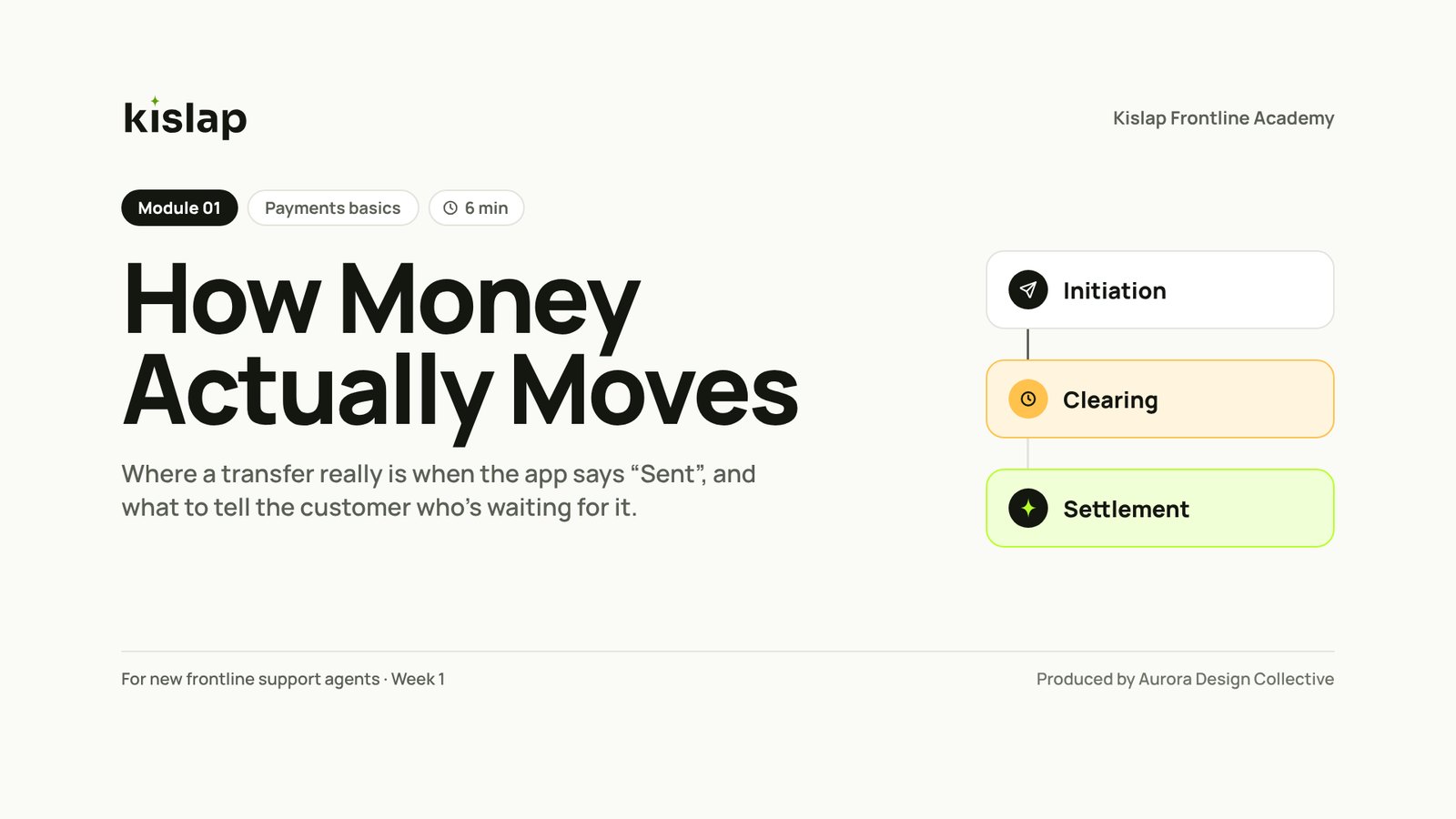
Every transfer moves through three stages. Once agents know which stage a transfer is in, they know whether they can fix it or only explain it.

-
1
Initiation
Kislap checks balance, limits and risk, then hands the instruction to the rail.
-
2
Clearing
The instruction is with the rail, on its way to the receiving bank.
-
3
Settlement
The receiving side credits the account. Only now has the money arrived.
How the course was designed
Who it is for, what each objective is taught by and tested with, and the decisions behind it.
New frontline support agents at a Philippine fintech, in their first 30 days.
At a desk with the agent console open, during onboarding week, often with live chats waiting.
How to use the app as a customer. Not how payment rails behave behind it.
Stop guessing timelines. Read the record, name the stage, explain it plainly.
Every objective has a scene and a question.
Pick one to see where it is taught and how it is tested.
Four design decisions
What we chose, and why. Timestamps point to where each one shows up.
- 0:00
One customer runs the whole module.
Rhea's ₱8,000 is followed from her chat to the console to the answer, so every concept arrives attached to a ticket agents will actually see.
- 0:25
Break the wrong picture first.
Agents imagine money flying between banks. The module replaces that image with two records and a message before teaching any stage.
- 3:00
Sort causes by whose side they are on.
Five stall reasons are split into "Kislap's side, you can fix it" and "rail or bank, explain only", which is the decision an agent makes on every ticket.
- 1:06
Motion only ever points.
One thing moves at a time and the screen holds still whenever there is something to read, so the console detail stays legible.
From a KB article to something agents can tell a customer.
Rewrite rules: One idea per sentence; status codes become stage names; "funds availability" becomes "arrived"; every rule is written as what the agent says or does.
A transaction in status SENT indicates the instruction has passed initiation controls… and has been transmitted to the selected settlement rail.
"Sent" means stage one finished, not that it arrived.
PESONet instructions received after the final daily cut-off, or on non-banking days, are queued for the next available clearing window.
Sent after the final cut-off, or on a weekend or holiday, it waits for the next banking day.
InstaPay instructions exceeding the per-transaction ceiling are rejected at initiation.
A transfer above the ceiling doesn't travel slowly. It doesn't start.
Agents must not commit to a funds-availability time not supported by rail schedules.
Set expectation from the rail, not from hope. Never invent a timeline.
Read the full source passage
KB-112: Outbound transfer status definitions. A transaction in status SENT indicates the instruction has passed initiation controls (balance verification, limit validation and risk screening) and has been transmitted to the selected settlement rail. Funds availability at the beneficiary institution is contingent on rail processing windows. PESONet instructions received after the final daily cut-off, or on non-banking days, are queued for the next available clearing window. InstaPay instructions exceeding the per-transaction ceiling are rejected at initiation. Agents must not commit to a funds-availability time not supported by rail schedules.
Sample source text written by ADC for this concept course. Kislap is a fictional brand.
Try the knowledge check
These are the questions agents answer at the end of the course. In your LMS, the score is recorded automatically through SCORM 1.2.
How a client would know it worked
The measures we recommend tracking after launch. A measurement plan, not results: concept courses have no learners yet.
Completion by onboarding wave
Every new agent finishes before taking live chats.
First-attempt pass rate, per question
A low Q1 score means the cut-off rule needs a refresher card.
Repeat contacts on one transfer
Fewer follow-ups within 48 hours is the main business signal.
QA review of replies
Sampled chats checked for invented timelines, before and after.
What a client would receive
- SCORM 1.2 package with the scored knowledge check
- MP4 master in 1080p
- Caption files (SRT and VTT)
- Full transcript
- Quiz questions and answers in an editable document